The Journal of Technology and Design is a peer-reviewed scientific journal that publishes original research, review articles, and case studies in the following fields:
Digital Technologies and Intelligent Systems
Artificial Intelligence (AI), Computational Intelligence,
Machine Learning, Data Science, Big Data,
Internet of Things (IoT), Digital Twin,
Robotics, Distributed Systems,
Information Security
Design-Driven Innovation,
Integrated Design Systems,
Smart Products and Services,
Smart Cities,
Living Labs,
Sustainable Design
Types of Manuscripts
Research ArticleReview ArticleMethods ArticleCase StudyApplied Research Article / Industry Practice ArticlePerspective / Viewpoint / Editorial ArticleCommentary / Discussion / Response Article
Publication Language
Submission Languages:
English and Vietnamese.
Abstract:
All manuscripts must include an English abstract of approximately 150–200 words.
Keywords:
4-6 keywords in English are required.
Peer Review Policy
JTD adopts a double-anonymous peer review process in accordance with international standards for scholarly publishing in Technology, Engineering, and Design. Authors and reviewers remain anonymous throughout the review process to ensure objectivity and fairness.
All stages are fully managed and displayed on the online submission system, allowing authors to track the status of their submissions throughout the review process.
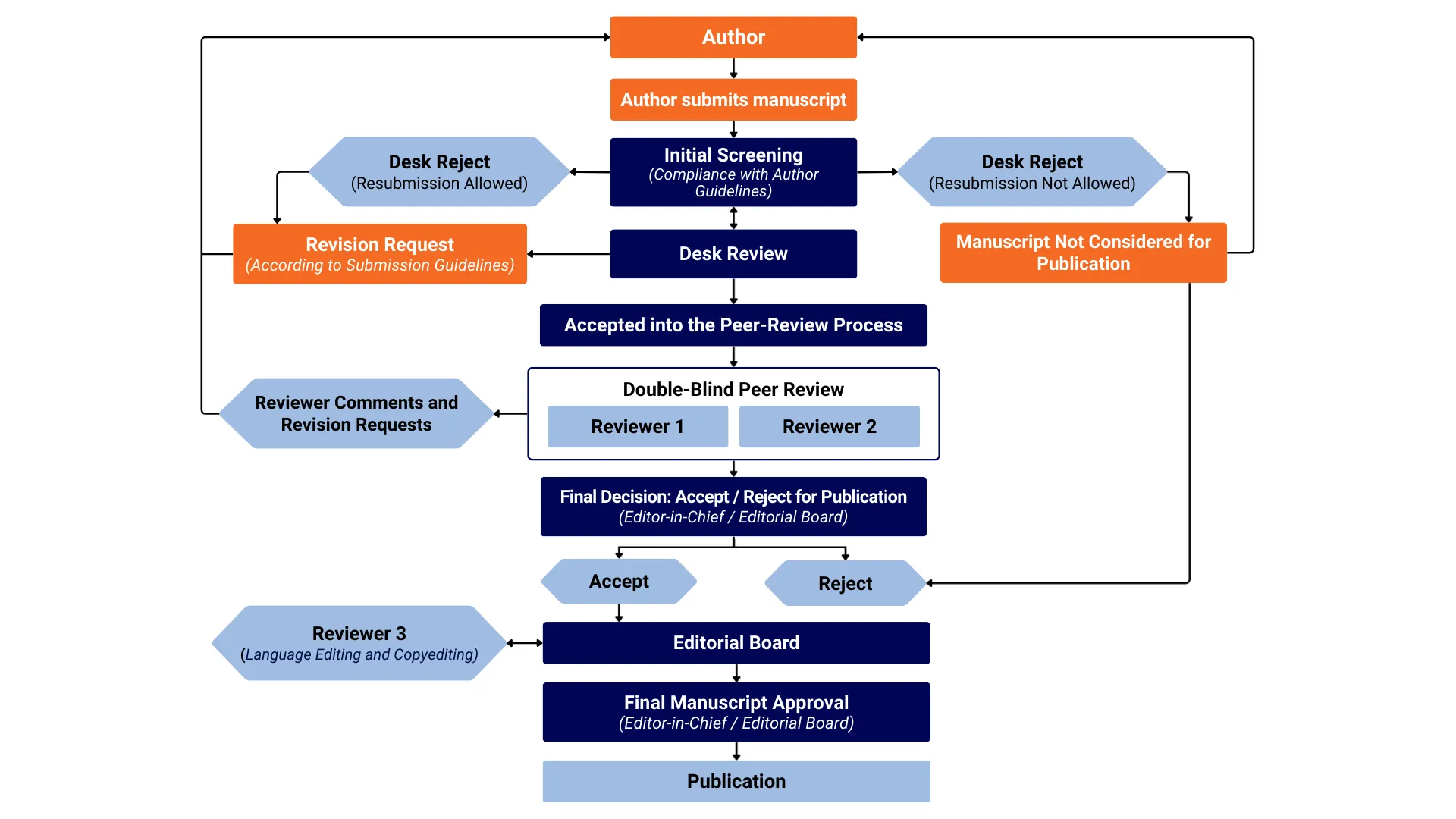
The editorial workflow consists of three main stages:
Initial Screening → Peer Review → Final Decision.
JTD EDITORIAL AND PEER REVIEW WORKFLOW
II. General Guidelines for Authors
The Journal accepts manuscripts written in either English or Vietnamese. However, all submissions must include an English Abstract (approximately 150–200 words) and English Keywords (4–6 keywords) to ensure international accessibility.
The manuscript must present original research within the scope of the journal. All authors must approve the submission and agree with the content of the manuscript.
The manuscript must not have been previously published or be under consideration by another journal.
The manuscript must comply with research ethics standards, including the absence of plagiarism, self-plagiarism, or falsified data. The journal reserves the right to use plagiarism detection tools and may reject manuscripts that violate academic integrity standards. .
Detailed formatting requirements are provided in
Section IV below
.
All references must follow the APA citation style and be arranged alphabetically by the first author’s surname. Every reference cited in the text must appear in the reference list, and vice versa.
Authors must provide complete submission information, including author names, affiliations, funding sources (if applicable), and a conflict of interest statement.
All submissions undergo a double-anonymous peer review process. Editorial decisions (acceptance, revision, or rejection) are made based on the recommendations of independent reviewers together with the Editorial Board.
To preserve the integrity of the double-anonymous peer review process, the main manuscript file must not contain any information that could identify the authors or their institutional affiliations.
Before submission, authors should prepare all required files, including the main manuscript, title page, and any supplementary materials (if applicable), to facilitate an efficient editorial and peer review process.
III. Submission Guidelines
3.1. Manuscript Preparation Checklist
Before submitting your manuscript, please ensure that:
The manuscript falls within the scope of the Journal.
The manuscript has not been previously published and is not under consideration by another journal.
All authors have approved the submission of the manuscript.
Please use an account registered under the identity of the Corresponding Author when submitting the manuscript.
The manuscript complies with the Journal's word-count and formatting requirements.
An English Abstract and Keywords are included.
All in-text citations are properly included in the reference list and follow APA (7th Edition).
The main manuscript has been anonymized and contains no author-identifying information.
All tables and figures are properly numbered and include appropriate captions.
The manuscript has been carefully checked for spelling, grammar, and overall language quality.
3.2. Submission Files
Please prepare the following files before submission:
1. Manuscript (Primary File)
Microsoft Word (.docx) format. The manuscript must not contain author names or any identifying information and should include the Title, Abstract, Keywords, Main Text, References, continuous line numbering, and page numbers.
2. Title Page (Separate File)
Includes all authors' names, affiliations, email addresses, ORCID iDs, corresponding author information, conflict of interest statement, funding statement, and author contribution statement.
3. Cover Letter
A brief statement (approximately 200–300 words) describing the significance of the manuscript, its relevance to the Journal, confirmation that it has not been published or submitted elsewhere, and disclosure of any conflicts of interest.
4. Supplementary Files (Optional)
Authors may submit supplementary materials such as datasets, appendices, images, videos, or other supporting documents to facilitate the review process and improve readers' understanding of the research.
3.3. Submission via the Online System
All manuscripts must be submitted through the
Journal of Technology and Design (JTD)
online submission system.
Please refer to the detailed submission guide
here.
Log in to your existing account or create a new account, then select
"New Submission"
to begin.
2
Enter Manuscript Information
Provide the required manuscript information in the submission form. Authors are also required to:
Review the Submission Checklist.
Agree to the Journal's submission requirements and policies.
Note: For manuscripts written in Vietnamese, authors must provide the Title, Abstract, and Keywords in both Vietnamese and English by selecting the English language option in the upper-right corner of the submission interface.
3
Upload Submission Files
Upload all required files. During the upload process, authors must select the appropriate file type for each uploaded document to ensure proper editorial processing and peer review.
At minimum, the Manuscript and Title Page files must be uploaded.
4
Add Contributors
Enter the information of all authors and contributors involved in the research in the correct order of contribution.
The user account used for submission will be designated as the Corresponding Author.
5
Complete the Submission
Authors may include a message for the Editorial Office, review all submission information, and click
"Submit".
A confirmation email will be automatically sent to the Corresponding Author after the submission has been successfully completed.
IV. Manuscript Formatting Guidelines
4.1. General Formatting Requirements
Requirement
Details
File Format
.docx (Microsoft Word)
Font
Times New Roman, 12 pt
Line Spacing
1.5
Margins
2.54 cm (1 inch) on all sides
Page Numbers
Include page numbers at the bottom-right corner of each page.
Line Numbers
Include continuous line numbering throughout the manuscript for peer review.
Research Article
6,000–10,000 words
Abstract
150–200 words (English abstract required)
Note: Word count excludes the abstract, keywords, tables, figures, and references.
4.2. Heading Hierarchy
Level 1: MAIN HEADING (ALL CAPS, Bold)
Level 2: Subheading (Title Case, Bold)
Level 3: Minor Heading (Sentence case, Italic)
4.3. Tables and Figures
4.3.1. Tables
Tables should follow the APA style and be presented clearly and consistently to support the analysis.
Table Title
Place the title above the table using the following format:
Table X. Description of the table.
Tables should be numbered consecutively (Table 1, Table 2, …) according to their order of appearance and must be cited in the text.
Formatting
Use three horizontal rules (top, header, and bottom).
Times New Roman, 11 pt.
Center the table on the page. Cell contents should be consistently left- or center-aligned.
Table Notes
Place notes directly below the table, beginning with Note.
Use notes to explain abbreviations, symbols, supplementary information, and statistical significance levels (e.g., p < .05, p < .01).
Example:
Ví dụ:
Table 1. Descriptive Statistics for AI-Generated vs. Human-Designed Interfaces
Variable
AI Design M (SD)
Human Design M (SD)
t
p
d
Aesthetic Appeal
5.2 (1.3)
5.4 (1.2)
-1.06
0.29
-0.16
Innovation
5.8 (1.1)
4.9 (1.4)
3.12
0.002*
0.47*
Functional Clarity
5.5 (1.2)
5.1 (1.3)
2.44
0.015*
0.37*
Emotional Engagement
4.2 (1.5)
4.8 (1.4)
-2.18
0.031*
-0.33*
Note. N = 175. AI = Artificial Intelligence; M = Mean; SD = Standard Deviation.
t and p values are from independent-samples t-tests.
*p < 0.05.
4.3.2. Figures
Figures (e.g., charts, diagrams, photographs, and illustrations) should be of high quality and directly support the manuscript.
Image Quality
Minimum resolution of 300 DPI for publication.
Images should be clear, sharp, and free from distortion or pixelation.
Accepted file formats: PNG, JPG, PDF, or EPS.
Figure Size
Figures should be appropriately sized to ensure readability.
Avoid figures that are excessively small or unnecessarily large.
Figure Caption
Place the caption below the figure.
Use the format: Figure X. Description of the figure.
The caption should be concise while providing sufficient information to understand the figure.
Figure Notes
Explain all symbols, abbreviations, colors, and legends used in the figure.
Report statistical significance where applicable (e.g., *p < .05).
Numbering and Citation
Number figures consecutively according to their order of appearance (Figure 1, Figure 2, …).
All figures must be cited in the manuscript.
Example:
Figure 1. Comparison of perceived design quality between AI-generated and human-designed interfaces. Error bars represent standard deviations. *p < 0.05.
4.4. Standard Manuscript Structure
1. TITLE
2. ABSTRACT
3. KEYWORDS
4. INTRODUCTION
5. LITERATURE REVIEW
6. METHODOLOGY
7. RESULTS
8. DISCUSSION
9. CONCLUSION
10. LIMITATIONS AND FUTURE WORK
11. ACKNOWLEDGMENTS
12. CONFLICT OF INTEREST
13. FUNDING
14. REFERENCES
15. APPENDIX
4.4.1. Title
Requirements:
The title should be approximately 10–15 words in length.
Clearly reflect the main content and contribution of the manuscript.
Avoid abbreviations and symbols unless they are widely recognized.
Avoid question-form titles except in exceptional cases.
Avoid vague or overly general wording.
Good Title Examples
"Design Innovation in Sustainable Packaging: A Machine Learning Approach"
"User Experience Design for Cross-Cultural Mobile Applications: A Vietnamese Case Study"
"Optimization of Robotic Arm Performance Using AI-Enhanced Control Systems"
Poor Title Examples
"Study on Technology" (Too broad)
"Is Design Important?" (Question-form title)
"New Methods in Tech & Innovation" (Avoid using "&")
"A Comprehensive Investigation into the Multifaceted Implications..." (Too long)
4.4.2. Abstract
An English abstract (150–200 words) is required for all submissions, including manuscripts written in Vietnamese.
Do not include citations or references.
Do not include figures, tables, or complex mathematical expressions.
Use clear, concise, and academically appropriate language.
Recommended Structure (Research Articles):
[BACKGROUND] Describe the research context and significance.
[OBJECTIVE] State the research objective or research question.
[METHODOLOGY] Briefly describe the research design, methods, and participants/data.
[RESULTS] Present the principal findings.
[CONCLUSION] Summarize the main implications and contributions.
4.4.3. Keywords
Provide 4–6 keywords.
Keywords must be written in English.
Each keyword may consist of a single word or a phrase (up to three words), separated by commas.
Avoid repeating words already used in the title.
Use indexing terms whenever possible.
Good Keyword Examples
Keywords: artificial intelligence, user experience design,
design automation, machine learning algorithms,
digital product design, human-computer interaction
Poor Keyword Examples
Keywords: technology, research, study, important
(Too broad and insufficiently specific.)
4.4.4. Introduction
Purpose:
Establish the research context and significance.
Identify the research gap.
Clearly state the research objective.
Present the research questions or hypotheses.
Recommended Structure:
General background.
Research context.
Research gap.
Research objective.
Research questions or hypotheses.
Organization of the manuscript.
4.4.5. Literature Review
Purpose:
Summarize relevant previous studies.
Identify research trends and knowledge gaps.
Establish the theoretical foundation.
Demonstrate the significance and necessity of the study.
Recommended Guidelines:
Organize the review by themes rather than by author or publication year.
Connect ideas across previous studies.
Highlight how the present study differs from existing research.
Avoid merely listing previous findings.
Critically evaluate the literature rather than simply summarizing it.
Use appropriate transitions to ensure logical flow.
4.4.6. Conflict of Interest
Requirements:
A Conflict of Interest statement must be included in every manuscript.
Authors should disclose any financial, professional, institutional, or personal relationships that could influence the research.
If no conflict of interest exists, please state: "The authors declare that they have no conflict of interest."
Format:
CONFLICT OF INTEREST
The authors declare that they have no conflict of interest related to this research.
4.4.7. Funding
Requirements:
Acknowledge all funding sources that supported the research.
Include the grant number where applicable.
Clearly identify the funding organization(s).
4.4.8. References
Requirements:
References must be arranged alphabetically by the surname of the first author.
Use APA (7th Edition) referencing style consistently throughout the manuscript.
Only references cited in the manuscript should be included in the reference list.
Include DOI information whenever available.
Research Articles are expected to include approximately 20–30 references, where appropriate.
4.4.9. Appendix
When to Use an Appendix:
To present supplementary materials that are not essential to the main text.
To include extensive source code or technical specifications.
To provide additional tables, figures, or datasets.
To include interview transcripts or survey instruments.
To present complex mathematical derivations or supporting materials.
V. Frequently Asked Questions (FAQ)
Yes. Manuscripts may be submitted in either English or Vietnamese. However, all submissions must include an English abstract (150–200 words) and 4–6 English keywords.
Authors typically receive the first editorial decision within 6–8 weeks after submission. If revisions are required, the complete peer review and revision process may take approximately 3–4 months.
Currently, the Journal does not charge any submission, processing, or publication fees.
Yes. Authors may request to withdraw their manuscript at any time before it is accepted for publication. After acceptance, withdrawal requests will only be considered under exceptional circumstances.
Accepted manuscripts are normally published within 2–3 months. Articles may be published online ahead of their inclusion in a scheduled journal issue.
Yes. Authors may submit a revised version after addressing the reviewers' and editors' comments. The resubmitted manuscript will be treated as a new submission and undergo the Journal's standard editorial and peer review process.